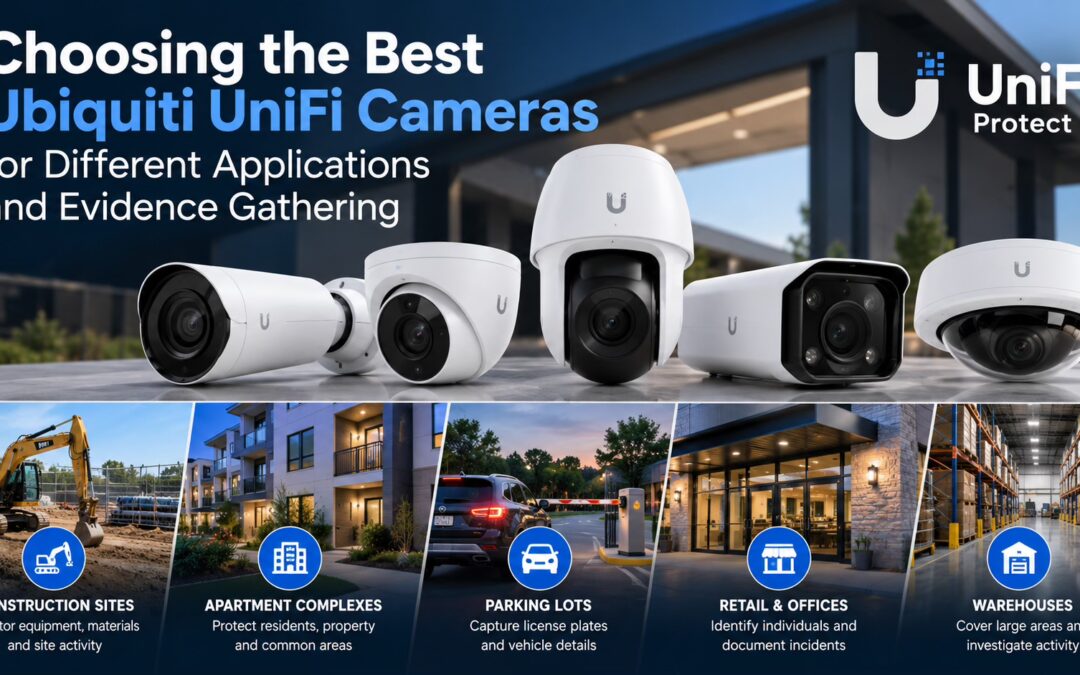
Learn which Ubiquiti UniFi Protect cameras work best for construction sites, apartments, parking lots, warehouses, and capturing valuable security evidence.
Not all security cameras are created equal. A camera that works perfectly for monitoring a parking lot may be a poor choice for identifying someone stealing equipment from a construction site. Likewise, a wide-angle camera that provides excellent coverage of a warehouse may not capture the facial details needed to identify a suspect.
When designing a surveillance system using Ubiquiti UniFi Protect cameras, the most important question isn't simply, "Which camera has the highest resolution?"
The better question is: "What do we need this camera to see, and what evidence will we need if something happens?"
At Kharma, we believe effective surveillance starts with understanding the property, identifying potential risks, and selecting cameras that can deliver useful footage when it matters most.
Understanding the Difference Between Monitoring and Evidence Gathering
There are three basic levels of surveillance coverage:
1. Detection — Knowing Something Happened
A wide-angle camera may reveal that someone entered a construction site after hours, but the person could be too small in the image to identify.
2. Recognition — Understanding What Happened
A properly positioned camera may show clothing, vehicle type, direction of travel, and other distinguishing characteristics.
3. Identification — Capturing Usable Details
A camera positioned at an entrance or another controlled location may capture a clear face, license plate, or other details that help investigators identify a person or vehicle.
A successful surveillance system often needs all three. Wide-angle cameras provide situational awareness, while dedicated identification cameras capture the details that matter most.
An important concept is pixels per foot (PPF). A high-resolution camera covering a very large area may deliver fewer useful pixels on a person's face than a lower-resolution camera aimed at a narrow entrance.
Resolution matters, but distance, lens selection, lighting, mounting angle, and motion blur matter just as much.
Best UniFi Cameras for Construction Sites and Equipment Yards
Recommended Camera: UniFi G6 Pro Bullet
Construction sites present unusual surveillance challenges. Equipment moves, lighting changes, temporary fencing is relocated, and valuable materials may be stored hundreds of feet apart.
The UniFi G6 Pro Bullet is an excellent option for monitoring equipment, material storage areas, entrances, and activity at greater distances.
Its 4K resolution and optical zoom capabilities allow installers to concentrate more image detail on specific areas where evidence may be needed.
For larger construction sites, we recommend combining fixed bullet cameras with PTZ cameras when active monitoring is required.
A G6 Pro Bullet aimed at a gate or equipment storage area can capture more useful identifying details than a single ultra-wide camera covering the entire jobsite.
Evidence Gathering Goal: Capture people entering restricted areas, vehicle descriptions, equipment movement, and the sequence of events surrounding a theft.
Best UniFi Cameras for Apartment Complexes and Condominiums
Recommended Camera: UniFi G6 Turret
Apartment communities need surveillance systems that can monitor multiple areas while providing useful evidence when incidents occur.
The UniFi G6 Turret is well suited for:
- Building entrances
- Breezeways and corridors
- Parking areas
- Stairwell approaches
- Community amenities
- Common spaces
Its 4K resolution, wide field of view, intelligent detection features, and infrared night vision make it a versatile choice for residential communities.
For apartment properties, the goal is often to document property damage, unauthorized entry, package theft, vehicle incidents, and activity in common areas.
Camera placement is especially important. Cameras installed too high may provide excellent coverage but poor facial identification.
For high-risk locations, a dedicated camera should be positioned to capture a more useful view of people entering and leaving the property.
Evidence Gathering Goal: Establish who entered an area, when they arrived, where they traveled, and whether they interacted with vehicles or property.
Best UniFi Cameras for Parking Lots and Vehicle Entrances
Recommended Camera: UniFi AI LPR
Capturing readable license plates is significantly more challenging than simply recording vehicles.
Headlights, reflective license plates, vehicle speed, and camera angles can make plates unreadable even with high-resolution cameras.
The UniFi AI LPR is designed specifically for license plate recognition applications.
It features 4K resolution, optical zoom, and specialized nighttime license plate capture capabilities.
For reliable evidence gathering, we recommend using two cameras at important vehicle entrances:
Camera 1: Dedicated License Plate Camera
The AI LPR is positioned to capture license plates as vehicles enter or exit.
Camera 2: Vehicle Overview Camera
A separate camera records the vehicle's color, make, model, direction of travel, and surrounding activity.
This combination provides significantly more useful evidence than relying on a single general-purpose camera.
Evidence Gathering Goal: Associate a vehicle's license plate with its appearance, direction of travel, and time of entry or exit.
Best UniFi Cameras for Retail Stores, Offices, and Building Entrances
Recommended Camera: UniFi AI Turret
In retail and office environments, surveillance should capture more than a person simply walking through a doorway.
The UniFi AI Turret provides 4K video, intelligent detection capabilities, face recognition features, and a vandal-resistant enclosure.
It is well suited for:
- Retail entrances
- Office reception areas
- Commercial building entrances
- Customer service counters
- High-traffic hallways
- Areas where facial detail is important
Properly positioned cameras can document a person's face, clothing, items carried, and interactions with employees or merchandise.
Special attention should be given to lighting. Glass doors and windows can create strong backlighting that makes faces difficult to identify.
Evidence Gathering Goal: Produce recognizable images of individuals and a clear timeline of interactions or incidents.
Best UniFi Cameras for Warehouses and Large Commercial Facilities
Recommended Camera: UniFi G6 PTZ
Warehouses, storage yards, and large commercial facilities often require surveillance across substantial distances.
A PTZ (Pan-Tilt-Zoom) camera can move horizontally and vertically while zooming in on suspicious activity.
PTZ cameras are particularly valuable when security personnel actively monitor a facility.
However, there is an important limitation.
A PTZ camera should not be the only camera responsible for recording critical evidence.
If the camera is pointed in one direction during an incident, activity occurring elsewhere may be missed.
For this reason, we recommend combining PTZ cameras with fixed cameras covering important entrances, loading docks, and equipment locations.
The fixed cameras maintain continuous coverage while the PTZ camera provides additional investigative capabilities.
Evidence Gathering Goal: Maintain continuous coverage of important locations while allowing operators to investigate suspicious activity in greater detail.
Why 4K Resolution Doesn't Always Mean Better Evidence
One of the most common misconceptions about security cameras is that installing 4K cameras automatically produces identification-quality video.
Consider two different installations.
Camera A: Wide Coverage
A 4K camera records an entire parking lot. A person standing at the far end may occupy only a small portion of the image.
Camera B: Focused Coverage
Another 4K camera is aimed at a narrow walkway. A person occupies substantially more of the image, increasing the potential for identification.
Both cameras have the same resolution, but Camera B may produce substantially better evidence.
This is why professional surveillance design considers pixel density.
Common approximate planning targets include:
- Detection: 8 pixels per foot
- Observation: 19 pixels per foot
- Recognition: 38 pixels per foot
- Identification: 76 pixels per foot
These are approximate industry planning guidelines, not guarantees of identification quality.
The installer must also evaluate shutter speed, lighting, nighttime performance, image compression, and movement.
Nighttime Surveillance: One of the Biggest Challenges
Many thefts, vandalism incidents, and unauthorized entries occur after normal business hours.
Although UniFi cameras offer infrared night vision, the manufacturer's rated infrared distance does not necessarily represent the distance at which a person can be identified.
For example, a camera may illuminate an object at a considerable distance while still failing to capture enough detail to identify a person's face.
A properly designed nighttime surveillance system should consider:
- Ambient lighting
- Supplemental infrared or white lighting
- Reflective surfaces
- Moving vehicle headlights
- Camera exposure settings
- Subject movement
- Motion blur
For critical identification locations, adding suitable white lighting may improve color detail and reduce motion blur.
The goal is not simply to see that someone is present. It is to capture enough detail to help determine who they are and what occurred.
Using UniFi Protect AI to Find Evidence Faster
One of the advantages of the UniFi Protect platform is its ability to organize recorded activity using intelligent detection features.
Depending on the camera model and installed accessories, UniFi Protect can support:
- Person detection
- Vehicle detection
- Face recognition
- License plate recognition
- Intelligent event searches
- Event notifications
These capabilities can significantly reduce the time required to investigate an incident.
For example, a property manager investigating a vehicle-related incident may be able to narrow a review to vehicle activity around a specific entrance rather than manually watching hours of footage.
Ubiquiti also offers additional on-premises AI processing through products such as AI Port and AI Key.
AI can help locate relevant footage, but automated identification results should always be verified against the original recording.
How to Preserve Security Camera Footage as Evidence
Selecting the correct camera is only half the job. Evidence must also be properly preserved.
When a serious incident occurs, we recommend following several important practices.
1. Export the Original Footage Promptly
Preserve the relevant recording, including several minutes before and after the incident.
2. Keep an Unmodified Master Copy
Avoid relying solely on screenshots, screen recordings, or heavily compressed video clips.
3. Document the Details
Record the camera location, date, time, time zone, and person responsible for exporting the footage.
4. Protect the Original File
Store the recording securely, restrict access, and consider calculating a cryptographic hash when formal evidence handling is required.
5. Maintain a Chain of Custody
Document who accessed, copied, transferred, or modified the evidence.
6. Preserve Related Camera Footage
An incident may involve several cameras showing different portions of the event.
Camera clocks should be synchronized to a reliable time source, and recording retention should be planned according to the number of cameras, resolution, frame rate, recording settings, and available storage.
When footage may be used in legal proceedings, applicable evidence rules and local laws should guide the preservation process.
The Best Surveillance Systems Use Multiple Camera Types
At Kharma, we believe the most effective surveillance systems combine different cameras to accomplish specific security objectives.
A construction site might need wide-area cameras to detect trespassing, optical-zoom cameras to document equipment theft, and a dedicated camera at the entrance to record arriving vehicles.
An apartment complex may need turret cameras in common areas, identification-focused cameras at entrances, and license plate cameras at vehicle access points.
A commercial warehouse may benefit from fixed cameras at loading docks, wide-angle coverage in storage areas, and PTZ cameras for investigating activity across a larger property.
The key is matching each camera to a specific purpose.
The best security camera is not necessarily the most expensive one. It is the camera that captures the details you need, at the location and time you need them.
Protect Your Property with Kharma
Whether you're protecting an apartment community, construction site, commercial building, warehouse, or equipment yard, Kharma can help design a UniFi Protect surveillance system around your property's risks and evidence requirements.
We offer managed Wi-Fi, surveillance systems, and on-demand surveillance solutions designed to help property owners and businesses improve security and visibility.
Don't just install cameras. Install a surveillance system designed to capture the evidence that matters.
Contact Kharma today to discuss the right surveillance solution for your property.
Website: https://gokharma.com
Phone: 501-371-0012